

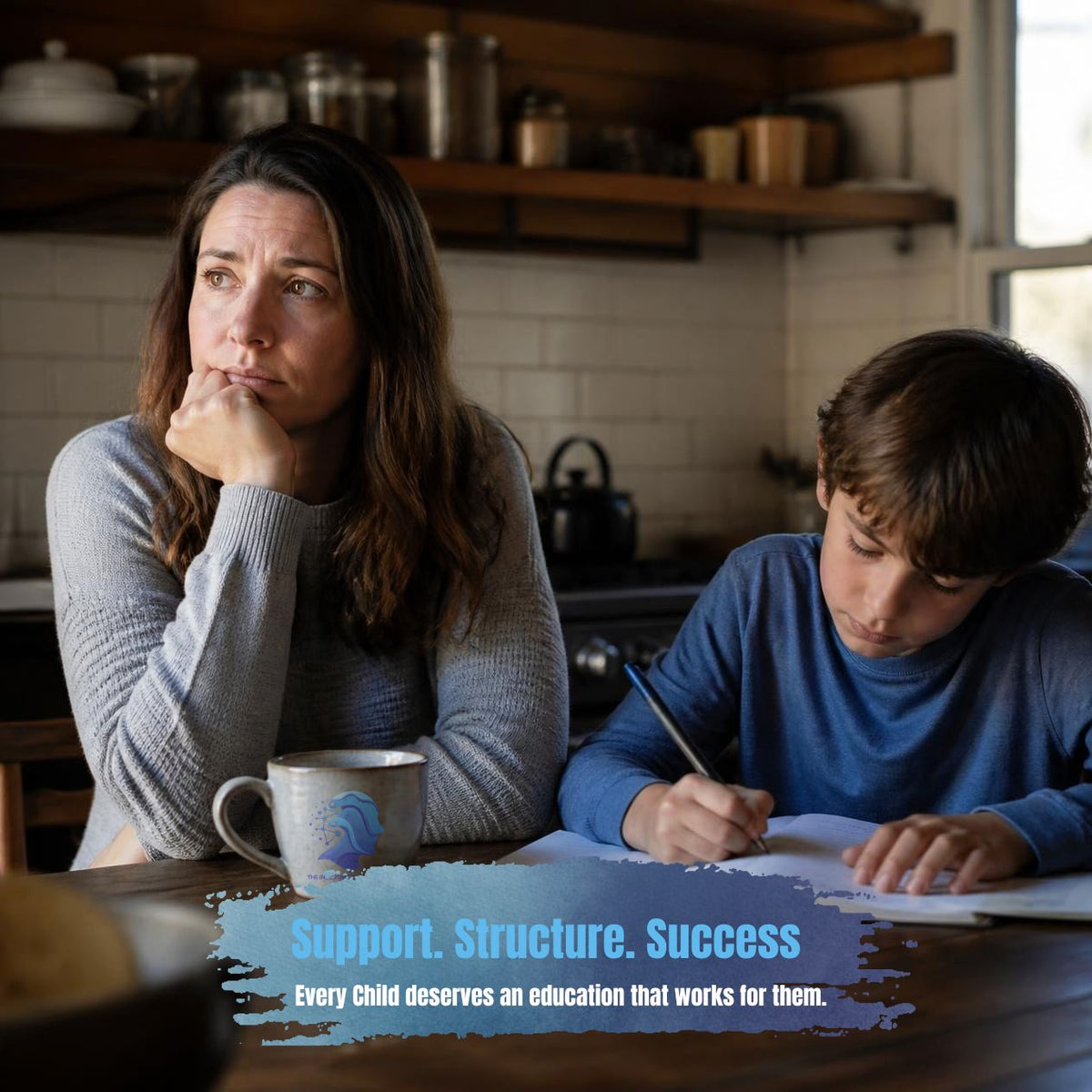
The Decision No Parent Ever Planned To Make
"I just want my child to be happy."
Those are probably the words we hear most often from parents considering home education.
Not:
"I want my child to leave school."
Not:
"I don't believe in mainstream education."
Not:
"I've always wanted to homeschool."
Simply:
"I want my child to be happy again."
Because watching your child become unhappy is one of the hardest things a parent will ever do.
Even harder is working out why.
You might have a fantastic relationship with your child. You know them better than anyone else in the world. You know their strengths, their interests, their personality and their sense of humour.
But children don't always tell us everything.
In fact, many children cannot explain what is wrong themselves.
Some children genuinely don't know.
Others are embarrassed.
Some are trying to protect their parents.
Others worry they won't be believed.
And then there are the children who simply shut down.
As parents, we often find ourselves becoming detectives, trying to piece together clues and understand why the child we know and love no longer seems themselves.
"Everything Was Fine In Primary School"
One of the most common stories we hear starts with exactly the same sentence.
"They were absolutely fine in primary school."
For years everything seemed straightforward.
They attended.
They learned.
They had friends.
They came home smiling.
Then Year 7 arrived.
And suddenly everything started changing.
Attendance drops.
Anxiety appears.
Confidence disappears.
Behaviour changes.
Homework becomes difficult.
School mornings become battles.
Parents often ask:
"What happened?"
The answer is usually far more complicated than anyone realises.
Think about the reality of the transition.
A child who has spent seven years in a relatively small primary school suddenly finds themselves in a school of over 1,000 pupils.
They go from being one of the oldest children to one of the youngest.
Sometimes they go from being one of the tallest to one of the smallest.
New teachers.
New classrooms.
New routines.
New friendship groups.
New expectations.
Different subjects.
Different teaching styles.
Different rules.
For many young people this transition is exciting.
For others it can feel completely overwhelming.
The Students Who Thrive And The Students Who Struggle
Secondary school works brilliantly for many young people.
Some students enjoy the independence.
Some enjoy being part of a bigger environment.
Some enjoy disappearing into the crowd and becoming less visible.
But not every child experiences secondary school in the same way.
Some students walk into a large school and thrive.
Others walk into the same environment and immediately feel overwhelmed.
The difference isn't ability.
The difference isn't intelligence.
The difference is often how that individual child experiences the world around them.
What may feel exciting for one young person may feel terrifying for another.
When SEND Needs Become More Difficult To Meet
For children with SEND or an EHCP, secondary school can introduce additional challenges.
Parents naturally assume that because an EHCP is in place, everything will continue exactly as it did before.
In reality, it can feel very different.
Your child may suddenly be one of many pupils with additional needs.
Teachers may have hundreds of students passing through their classrooms every week.
Support staff may be supporting numerous young people across multiple year groups.
This doesn't mean schools don't care.
Far from it.
But it can sometimes mean that parents begin questioning whether every identified need is being fully understood and consistently supported throughout the school day.
Many parents find themselves asking:
- Are all the provision requirements actually happening?
- Does every teacher understand my child's needs?
- Is my child getting the support they need to access learning?
- Are they coping emotionally as well as academically?
These questions are completely understandable.
Because whilst every parent wants their child to grow, become independent and face challenges, they also want them to feel safe, valued and happy.
When Routine Stops Feeling Safe
Routine is often one of the biggest strengths of school.
Children know where they need to be.
They know what happens next.
They have structure.
For many children, routine creates security.
But what happens when that routine stops feeling predictable?
A timetable may look structured on paper.
Yet for some children:
- Teachers change regularly.
- Cover staff step in.
- Friendship groups shift.
- Expectations increase.
- Subjects become harder.
Suddenly what once felt safe feels uncertain.
For some learners, particularly those with anxiety or SEND, this can have a significant impact.
When SEMH Needs Become EBSA
Many families first hear the term EBSA after months or even years of difficulties.
Emotionally Based School Avoidance rarely happens overnight.
It often develops gradually.
Small worries become bigger worries.
A missed day becomes several missed days.
Attendance falls.
Confidence falls.
Pressure rises.
Family stress increases.
Parents often reach a point where every school morning feels like a battle.
The difficult reality is that by the time many families seek help, everyone is exhausted.
The young person.
The parents.
The school.
And often relationships have become strained despite everybody wanting the same outcome.
Teenage Years Bring New Challenges
For others, the difficulties don't appear until much later.
Children change.
Teenagers change.
Friendships become more complicated.
Peer pressure grows.
Academic expectations increase.
Bodies change.
Hormones change.
Social media introduces an entirely new layer of pressure.
At the same time, gaps in learning may begin to emerge.
A child misses a few lessons.
Those missed lessons create gaps in knowledge.
Those gaps make future lessons harder.
Confidence reduces.
Engagement reduces.
Attendance reduces.
Which creates even more gaps.
Before anyone realises, a downward spiral has formed.
Behaviour Is Often The Symptom, Not The Cause
Sometimes parents begin considering alternative education because of behaviour concerns.
Other students may be disrupting lessons.
Bullying may be occurring.
Serious behavioural incidents may be affecting the school environment.
Parents naturally ask themselves:
"What impact is this having on my child?"
Because ultimately your priority is your child's wellbeing, education and future.
But there is another side to this discussion too.
Sometimes the child displaying challenging behaviour is struggling themselves.
Many young people are not "naughty."
Many are overwhelmed.
Many are frustrated.
Many feel unsuccessful.
Imagine being a child with ADHD expected to sit still for long periods of time.
Imagine being a child with unidentified learning difficulties who doesn't understand the work being presented.
Imagine being a child whose needs require a small nurturing environment but who is learning in a class of thirty-two students.
For some learners this can lead to:
- Walking out of lessons
- Refusing work
- Isolation rooms
- Suspensions
- Exclusions
And the pressure on families grows even further.
When Parents Reach Their Limit
Eventually many parents reach a difficult question:
"How much more can we take?"
Not because they don't love their child.
Not because they've given up.
Quite the opposite.
They're exhausted because they care so much.
It can affect:
- Family relationships
- Siblings
- Employment
- Finances
- Physical health
- Mental health
And often parents feel guilty for even admitting how hard things have become.
The truth is that supporting a struggling child can be emotionally draining.
No parent should feel ashamed of that.
Home Education Is Not Always The Answer
This is important.
Home education is not always the answer.
For some families, additional support within school works.
For others:
- Flexi-schooling
- Alternative Provision
- Online learning
- Additional SEND support
- Therapeutic interventions
may be more appropriate.
The goal is not to remove children from school.
The goal is to find an educational solution that allows them to thrive.
The Most Important Thing? Everybody Working Together
When difficulties arise, it is easy for relationships to become strained.
Parents become frustrated.
Schools become frustrated.
Young people become frustrated.
But nobody wins when people work against each other.
The most successful outcomes almost always happen when everybody works together:
- Parents
- Schools
- SEND teams
- Alternative providers
- Therapists
- Local Authorities
- Most importantly, the young person themselves
Because every child deserves an education that works for them.
Not just academically.
Emotionally too.
You're Not Alone
Home education has grown significantly across England in recent years, with increasing numbers of families exploring alternatives to traditional schooling. [commonslib...liament.uk], [gov.uk]
The challenge isn't deciding whether education matters.
It's deciding what type of education is best for your child.
How The Inclusive Classroom Can Help
Many parents want home education support but don't want to become full-time teachers.
That's exactly why we created:
Homework Hub (£24.99/month)
Perfect for parents wanting structured learning support and personalised learning pathways.
Live Study Hub (£49.99/month)
Adds teacher guidance, live support and accountability.
Home Education Academy (from £99/month)
Our most comprehensive option, providing structured timetables, personalised learning plans, progress tracking and ongoing teacher support.
➡️ Explore our Home Education Academy to discover whether home education could work for your family.


